UiPath
Attended vs Unattended Robots in UiPath: Which Do You Need?
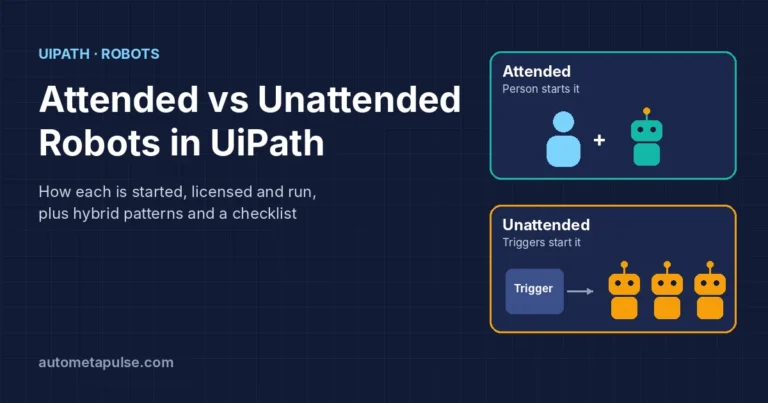
Attended vs unattended robots in UiPath compared: how each is triggered and licensed, where it runs, hybrid patterns and a checklist to pick the right one.
Practical tutorials, thoughtful workflows, and implementation guidance to help teams automate the work that slows them down — with clarity, control, and room to grow.
Explore platform-specific guidance and learn how to design automations people can trust, maintain, and improve.
Build cloud flows, approvals, integrations, and reliable process automations with practical walkthroughs.
Explore learning path →Learn RPA patterns, exception handling, queues, testing, and maintainable automation projects.
Explore learning path →Explore bot design, reusable logic, integration patterns, and production-minded operations.
Explore learning path →Combine AI-assisted tasks with sensible validation, human review, privacy, and guardrails.
Explore learning path →Break down process problems, design trade-offs, testing, and verifiable outcomes.
Explore case studies →Build your automation practice with planning canvases, testing checklists, and documentation guides.
Browse resources →A useful automation is more than a happy-path demo. It fits the real process, handles exceptions, respects access boundaries, and gives the team a way to operate it confidently.
Step-by-step tutorials and real implementation notes, published as I build and test them.
Attended vs unattended robots in UiPath compared: how each is triggered and licensed, where it runs, hybrid patterns and a checklist to pick the right one.
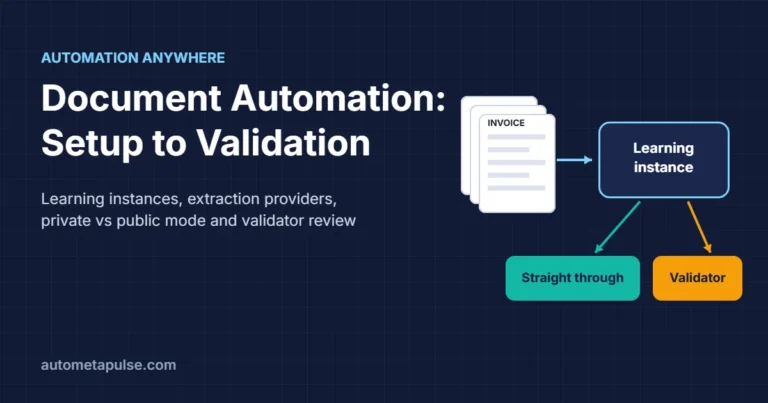
Set up Automation Anywhere Document Automation step by step: roles, learning instances, extraction providers, private vs public mode and how validation works.
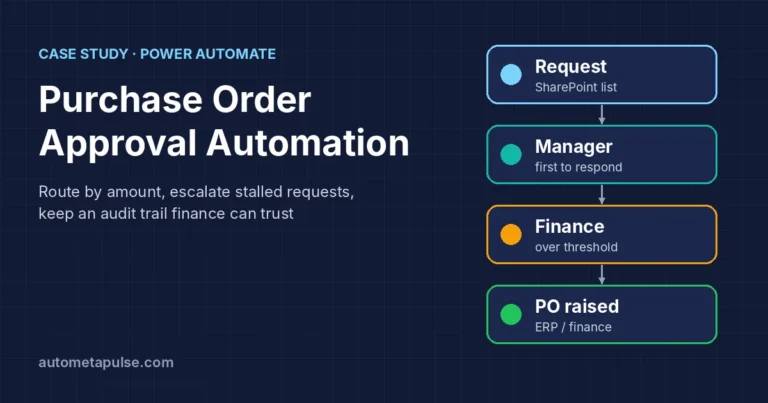
Purchase order approval automation with Power Automate: an illustrative case study covering the approval matrix, flow design, escalations and audit trail.
Useful project write-ups explain the baseline, the design decisions, and the limits of the result.
Record volume, manual steps, exceptions, systems, ownership, and the method used to measure the baseline.
Problem discovery ↗Show why the platform was chosen, where validation happens, and how failures are handled.
Implementation notes ↗Include the measurement period, relevant assumptions, limitations, and what still needs improvement.
Lessons learned ↗Automation tools keep changing. A useful knowledge base grows by documenting experiments, what failed, and how an implementation can be improved.
I’m Shubham Verma, an RPA developer and automation engineer with 8.5 years of experience. I currently build enterprise automations at BDO India, after three years delivering RPA projects at TCS. My work spans Power Automate, Power Automate Desktop, UiPath and Playwright (JavaScript), across tax, compliance, finance, healthcare and insurance processes.
I started Autometapulse to share what actually works in real projects: step-by-step tutorials, workflow breakdowns and honest lessons learned. If you have a process you’d like to automate, I also take on paid consulting projects. Let’s talk →
Every tutorial covers the real problem, what I tested, what didn't work, and how the final workflow stays maintainable.
New tutorials are added regularly. Check the blog for the latest guides.
For now, you can revisit the blog to see newly published tutorials, implementation notes, and lessons learned.
Read the latest articlesDescribe the current workflow, the systems involved, and the outcome you want. A focused discovery conversation is the first step toward a sensible plan.